Bank of Canada Cuts Rates for Third Time: What Homebuyers and Investors Need to Know

Three Consecutive Rate Cuts: What’s Next for the Canadian Economy?

In a highly anticipated move, the Bank of Canada (BoC) has lowered its key interest rate by 25 basis points, bringing it down to 4.25%. This marks the third consecutive cut since June, signaling the central bank’s ongoing efforts to navigate the complexities of Canada’s economic landscape. While the reduction was largely expected, the broader implications of this decision reflect the central bank’s cautious approach to managing inflation and sustaining economic growth.


Why the Rate Cut Matters

The Bank of Canada’s decision to reduce the policy rate has wide-reaching effects, particularly for consumers and businesses who rely on borrowing. The current 4.25% rate directly influences variable mortgage rates, lines of credit, and business loans, making the cost of borrowing slightly more manageable. However, while these cuts offer some relief, their impact may be muted, especially for the housing market, which continues to face persistent challenges.

Governor Tiff Macklem emphasized that while inflation has cooled to 2.5%, it remains stubborn in areas like housing, where shelter costs are running at over 8%. Housing represents a significant portion of consumer spending, and despite easing in other sectors, this is one area where inflationary pressures remain high, complicating efforts to bring overall inflation down to the BoC’s 2% target.


Impact on the Housing Market

For those looking to buy a home, the latest rate cut might offer modest savings, but experts caution that it’s unlikely to dramatically shift the housing market. A 25-basis-point cut, for instance, results in a savings of approximately $125 per month on a $500,000 loan for a buyer with a variable rate mortgage. While this can provide some financial relief, it’s not a game-changer for most prospective buyers, many of whom continue to face affordability issues amid high housing costs.

Local real estate professionals are observing that these incremental cuts are helping to stabilize, but not fully stimulate, the housing market. For those already in the market or looking to enter it, these rate adjustments signal an improvement, but not enough to fully counteract the high costs associated with homeownership today.
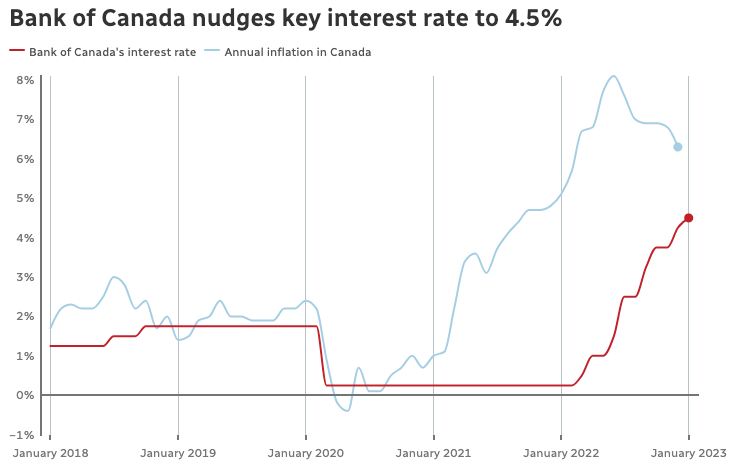
Source: Bank of Canada, Statistics Canada

Chart: Graeme Bruce | CBN News

Employment and Broader Economic Implications

Another concern for the Bank of Canada is the labor market, which has shown signs of softening. The unemployment rate has climbed to 6.4%, with a notable impact on youth and newcomers. While wage growth remains elevated, it is expected to slow as the slack in the labor market persists. The BoC is closely monitoring these dynamics, as they will influence future decisions about the pace and size of any additional rate cuts.

Globally, economic growth has been better than expected, particularly in the U.S., where consumer spending continues to drive the economy. However, slowdowns in other major economies, like China, and overall weaker labor markets add uncertainty to the global outlook. For Canada, maintaining economic momentum while balancing inflationary pressures is key.


What’s Next for Interest Rates?

Looking ahead, Governor Macklem has left the door open for further rate cuts, potentially as soon as October, depending on how the economy performs in the coming months. The central bank is carefully assessing the risk of inflation either falling below the 2% target or remaining too high. While a 25-basis-point reduction was seen as a prudent move, larger cuts could be on the table if economic conditions worsen or inflation proves more persistent.

Many economists predict that we could see another rate cut before the end of the year, with the potential for continued easing into 2025. However, this will depend on incoming data, particularly around employment, inflation, and consumer spending.


The Bank of Canada’s latest interest rate cut is part of its broader strategy to guide the Canadian economy toward a “soft landing” as it aims to balance inflation control with sustainable growth. While the rate reduction provides some relief, particularly for borrowers, its immediate effects may be less dramatic than some had hoped. The housing market, in particular, remains a challenge, and the BoC’s focus will likely remain on managing inflationary pressures in this sector.

As the central bank continues to assess economic conditions, Canadians can expect a measured approach to monetary policy, with the potential for further rate cuts if needed. For now, the BoC remains committed to restoring price stability while keeping the economy on course for a stable and prosperous future.

Share This Article

Jeff Neumann reflects on his early real estate career, the evolution of MLS access, and why trust, e
By Jeff Neumann June 17, 2026
Jeff Neumann reflects on his early real estate career, and why trust, expertise, and adaptability—not information alone—remain the foundation of long-term success.
June 10, 2026
On June 10, 2026, the Bank of Canada announced it is maintaining its target for the overnight rate at 2.25%, with the Bank Rate at 2.50% and the deposit rate at 2.20%. The decision comes as global uncertainty persists, driven by ongoing geopolitical conflict, energy market volatility, and continued trade policy tensions. Rising oil prices and supply chain disruptions are contributing to inflationary pressure while also weighing on global economic growth. Global Economic Trends Remain Generally Steady In the United States, growth remains solid, supported by consumer spending and AI-related investment. In contrast, the euro area continues to see weaker growth as higher energy costs weigh on activity. China’s economy remains more stable, supported by strong export demand. Global financial conditions have loosened since the last Monetary Policy Report, with strong equity markets and continued volatility in bond yields. The Canadian dollar has also weakened against the US dollar and other major currencies. Canadian Economy Shows Soft Momentum Recent data shows the Canadian economy contracted slightly in the first quarter, with GDP edging down by 0.1%. While consumer spending increased, declines in government spending, housing activity, business investment, and exports weighed on overall growth. Employment increased in May, but overall labour market conditions remain soft, with unemployment holding between 6.5% and 7%. Even with expected near-term improvements, the economy is still projected to operate with excess supply. Inflation Remains Elevated but Moderating CPI inflation rose to 2.8% in April, largely driven by higher energy prices, including oil and the removal of the consumer carbon tax from the year-over-year comparison. Core inflation has eased closer to 2%, and broader price pressures remain more contained. Food inflation has moderated but remains elevated, while shelter inflation continues to ease. Overall inflation is expected to remain near 3% in the near term before gradually moving back toward the Bank’s 2% target. Policy Decision And Outlook Against this backdrop, the Governing Council decided to maintain the policy rate at 2.25%. The Bank noted ongoing weakness in domestic growth, persistent global uncertainty, and elevated energy prices. While it continues to look through short-term inflation impacts from energy, it emphasized it will not allow these pressures to become entrenched in long-term inflation trends. The Bank remains committed to supporting price stability and will respond as needed as economic conditions evolve. Looking Ahead  The next scheduled announcement for the overnight rate is July 15, 2026, when the Bank will also release its next Monetary Policy Report. Until then, borrowing conditions are expected to remain relatively steady as markets continue to adjust to evolving global and domestic economic signals. Have questions about how this may impact your buying or selling plans? Contact us today to discuss your next steps in today's market.
April 29, 2026
The Bank of Canada announced it is maintaining its target for the overnight rate at 2.25%, with the Bank Rate at 2.50% and the deposit rate at 2.20%.
April 7, 2026
It’s finally starting to feel like spring in Guelph. Wherever you're living, this time of year brings a fresh perspective to every space.
March 18, 2026
On March 18, 2026, the Bank of Canada announced it is holding its target for the overnight rate at 2.25%, with the Bank Rate at 2.50% and the deposit rate at 2.20%.
By Explore Guelph’s Best Easter Festivities. March 10, 2026
Easter in Guelph is a season full of energy, family fun, and community spirit.
By Family Fun and Irish Cheer in Guelph. March 5, 2026
March in Guelph turns a little greener as the community comes together to celebrate St. Patrick’s Day.
By Exciting local activities happening all week long - March 14-22 March 2, 2026
March brings a vibrant energy to Guelph, with the city alive with events and activities that celebrate the season.
February 1, 2026
Discover February events in Guelph, from family fun and social fundraisers to live entertainment and adults-only nights out.
Calendar, Ontario Stat Holidays Calendar
January 14, 2026
2026 Ontario Statutory Holidays: Key Dates to Know. This overview is here to help you stay ahead in 2026. Whether you’re organizing staff schedules, planning a vacation, or simply counting down to your next break, knowing when Ontario’s stat holidays fall can help you stay prepared and stress-free throughout the year.
More Posts